
Project Overview
How a FLANDERS field service team restored a rare tandem armature motor system at a northern Indiana metal manufacturing mill during a single scheduled outage, avoiding what would have been a minimum of four weeks of offsite repair time.
A Scheduled Outage, a Rare Motor Configuration, and No Time for Offsite Repair
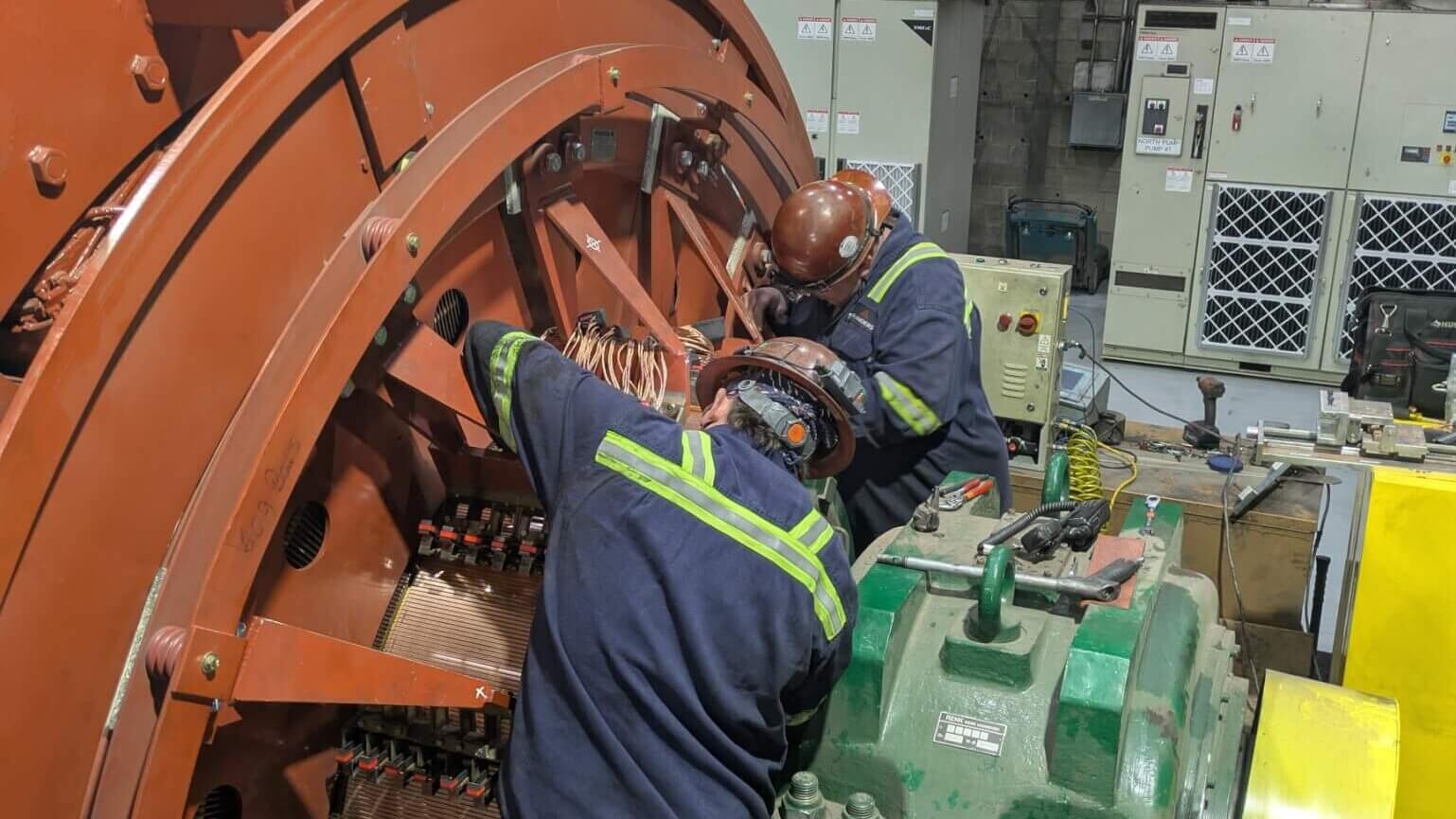
The two DC motors powering this northern Indiana metal manufacturing mill are not standard equipment. They are tandem armature motors, a configuration where two 5000HP motors share a single common shaft, each with its own commutator, winding, and field frame. When commutator wear from sustained operational loading reached the point where it needed to be addressed on both motors, the maintenance team faced a straightforward problem with no simple solution.
Sending either motor to a repair facility was not a realistic option. In the best case, offsite work on a single commutator takes a minimum of two weeks. With two commutators on two motors, both needing correction, the operation was looking at potentially four or more weeks of downtime per motor pulled, and the disruption of rigging out equipment of this size and complexity from an active production facility.
The outage window was scheduled and fixed. The repair had to fit inside it.
When the Equipment Cannot Move, the Repair Has To.
FLANDERS deployed a four-technician field service team to the mill. Two technicians worked each motor simultaneously, completing both commutator restorations within a single 12-hour shift. The technique used was onsite auto-stoning, a commutator restoration process performed with the equipment in place that eliminates the need to disassemble, transport, and lathe the armature offsite.
For the specific wear condition on these motors, auto-stoning was the right technical choice, not simply the convenient one. The wear was the result of operational loading rather than severe mechanical damage, which placed it well within the parameters where auto-stoning outperforms turning.
The advantages of auto-stoning in this application:
- Performed in service without disassembly, eliminating transport time and the logistical complexity of moving large rotating equipment
- Preserves commutator material by removing only surface films, high mica edges, and minor irregularities rather than cutting away copper as turning does, extending the lifespan of the commutator
- Maintains proper brush seating by restoring a smooth, uniform surface matched to brush contour, improving contact and reducing sparking
- Improves commutation performance by removing glazing, carbon deposits, and surface roughness that cause arcing and reduce current transfer efficiency
- Avoids the mechanical risks of lathe turning, including eccentricity and poor surface finish from imprecise setup, when only minor correction is needed
Both motors were returned to full operating condition within the scheduled outage window. The mill came back online on schedule.
Completing this repair on site kept the customer's outage on schedule and avoided nearly a month of additional downtime. No electric motor is too much for FLANDERS. When downtime isn't an option, we bring the solution to you.
— Blake Craney, Field Service Manager, FLANDERS
Keeping the Outage on Schedule
Four technicians. Twelve hours. Two commutators on two motors, both completed in a single shift.
Offsite repair on one commutator carries a minimum two-week turnaround in the best case. Pulling both motors for offsite work on both commutators would have meant weeks of downtime and the full cost and disruption of removing large, complex equipment from an active production facility. The onsite approach eliminated that entirely.
The motors have been running without any signs of returning wear since the work was completed in early March 2026. FLANDERS has continued to perform field service work in that unit for the same customer, a relationship built on consistent delivery that has made complex repairs a routine part of their maintenance program rather than a production event.
Why More Mill Operations Are Choosing Field Repair Over Facility Repair
The conventional assumption in heavy industrial motor repair is that complex work requires a controlled environment, a shop, a facility, and the right fixed equipment. The tandem armature motor restoration at this northern Indiana mill is a clear example of what becomes possible when that assumption is challenged.
Commutator wear from operational loading is a predictable maintenance event. What is less predictable is whether the team handling it has both the technical judgment to choose the right restoration technique and the field capability to execute it with precision. Auto-stoning requires both, and when applied correctly it delivers results that protect equipment life, preserve commutator material, and return motors to service faster than any alternative.
For metal manufacturing operations and other heavy industrial facilities running on fixed maintenance windows, that combination is not a marginal advantage. It is the difference between an outage that stays on schedule and one that does not.
Plan Your Next Motor Repair Around the Outage
A worn, sparking or irregular commutator does not automatically mean that a large DC motor must be removed and shipped to a repair facility.
Our team can evaluate the equipment, determine whether an onsite repair is technically appropriate and develop a plan around your production and outage requirements. Click here to learn more about FLANDERS onsite motor inspections, commutator repair, diagnostics and field service support for heavy industrial operations.
Request an onsite motor evaluation before your next planned outage.
About FLANDERS
FLANDERS is a leading global provider of industrial electrical and automation solutions, headquartered in Evansville, Indiana. For over 75 years, our company has specialized in electric rotating machines and advanced automation technologies for heavy industries including mining, mills, power generation, marine, and beyond.