
Project Overview
How operating data from a FLANDERS Idle Management System pilot helped identify avoidable fuel consumption and build a measurable OPEX savings case for a mining operation.
A Haul Truck Ready for Work and Still Burning Fuel
At a mine site, a haul truck can be mechanically ready, fully staffed and consuming fuel without moving a single tonne of material. A few minutes of idling may appear insignificant during one shift. Across a large fleet operating around the clock, however, those minutes can become a substantial operating expense.
Reducing unnecessary idling is not as simple as instructing operators to shut down their engines. Haul trucks operate within demanding production cycles and must remain available when work resumes. Shutdown decisions must account for truck status, operating conditions, safety requirements, and the needs of supporting systems.
The challenge for mine leaders is determining how much idling is operationally necessary, how much is avoidable, and whether addressing it can deliver enough value to justify the investment.
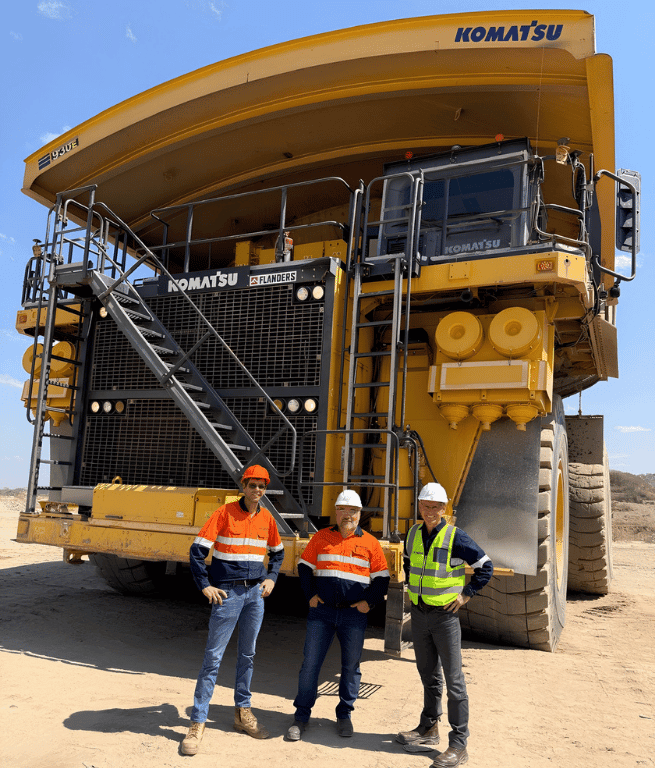
A mining operation in Southern Africa evaluated the FLANDERS Idle Management System on a Komatsu 930E-5 to answer those questions using actual operating data.
When the Truck Does Not Need to Run, Idle Management System Steps In
FLANDERS IMS monitors defined truck conditions and automatically shuts down the engine only when established operating criteria are met. When the truck is required to return to service, the system allows it to restart and resume operation in about 2 seconds, guaranteeing a hot start, with which the engine is protected against any undesired operating condition.
The purpose is not to shut down the engine at every possible opportunity. It is to apply shutdown logic consistently when the truck can safely stop consuming fuel without compromising its readiness or normal production requirements.
The engine will only shut down when certain conditions are met, for example:
- Truck velocity = zero
- Park brake applied
- Engine OEM conditions met for safe and efficient stop (thermos, pressures, etc.)
The engine will restart again in seconds if any of the following conditions:
- Operator touch pedals or steering
- The park brake is released
- Any of the engine OEM specifications are not in range
The advantages of auto-stoning in this application:
- Reduces fuel consumed during avoidable idling cycles, by switching the engine off and entering a ready to work state using truck specific operating data.
- Applies shutdown rules consistently across shifts and operators
- Increase time between overhauls of the truck engine and other main components by reducing unnecessary engine hours.
- Reduce the number of planned maintenance events, and associated cost per annum, due to lower engine hours per annum.
- Reduced engine hours per month leads to reduced OPEX spending in the case of Maintenance and repair contracts which are based on engine hours
- Creates measurable data for evaluating potential OPEX savings
- Provides insight into remote condition monitoring and advanced data analytics
Both motors were returned to full operating condition within the scheduled outage window. The mill came back online on schedule.
The value is not simply shutting down an idling engine. It is giving a mine the operating data needed to understand where fuel is being consumed unnecessarily and whether idle management can produce a meaningful return.
— Kim Weninger, Executive Chairman, FLANDERS
The pilot gave us a clearer view of how much fuel was being consumed while the truck was idling. That data created a practical way to evaluate the potential savings so much so that we have begun evaluating a broader fleet deployment.
— Mining Operator, Africa
Turning Idle Time into a Measurable OPEX Opportunity
Data collected during the evaluation was used to estimate the financial opportunity associated with reducing avoidable idle time. Based on the observed pilot activity and assumptions contained in the original proposal, the analysis projected the following annual savings:
- Fuel consumption reduction ~5% to 8%
- Engine life extension +20% (1 252 engine hours saved per year)
- Reduction of 5 planned maintenance events per year led to OPEX savings
- Increased availability (5 less PMs/year)
- CO2 reduction (+90 ton CO2 reduced per year)
Why Site-Specific Data Matters
Truck utilization, haul profiles, queue times, climate, fuel pricing and operating behavior vary from site to site. Applying a generic savings percentage across an entire fleet may create an attractive estimate, but it does not provide the same confidence as data collected from the mine’s own trucks.
For mine managers and operations leaders accountable for OPEX, that distinction matters. Site-specific data makes it possible to evaluate the opportunity, test the assumptions, and determine whether a broader deployment is financially justified.
How Much Is Unnecessary Idling Costing Your Haul Truck Fleet?
Every mine operates differently. FLANDERS can evaluate your haul truck fleet’s idle time, estimate potential fuel and operating cost savings, and help build a business case based on your actual operating conditions.
Find out what idle management could save your operation.
Request a FLANDERS Idle Management Savings Assessment
About FLANDERS
FLANDERS is a leading global provider of industrial electrical and automation solutions, headquartered in Evansville, Indiana. For over 75 years, our company has specialized in electric rotating machines and advanced automation technologies for heavy industries including mining, mills, power generation, marine, and beyond.